
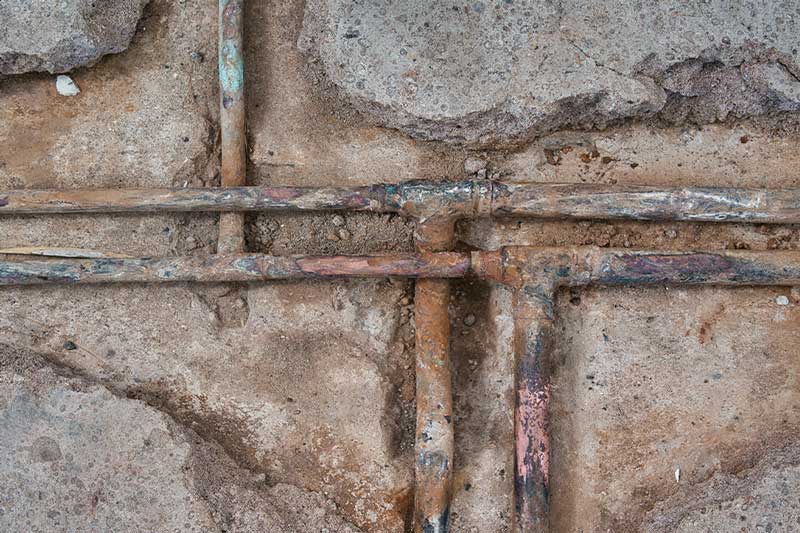
Slab leak repair for older Franklin homes generally takes one of three forms: a spot repair that opens a small section of slab to fix the damaged pipe directly, a repipe that reroutes water lines and abandons the failed run under the slab, or a trenchless repair that works through limited access points. The right approach depends on the age and condition of the piping, how many leaks have occurred, and the home’s construction. Acting quickly matters because water under a foundation causes structural damage, mold growth, and rising utility costs the entire time it goes uncorrected.
In our work throughout Franklin, slab leaks concentrate in the slab-on-grade homes built from the 1960s through the 1980s, where original copper supply lines have now been in the ground for decades.
What Causes Slab Leaks and What Are the Symptoms?
Slab leaks occur when water supply lines beneath a home’s foundation crack, corrode, or separate at a joint. Common causes include shifting soil, abrasion against the concrete, poor original installation, water chemistry, and simple age-related deterioration of the pipe material.
The symptoms are recognizable once you know what to watch for. Unexplained dampness on floors is one of the clearest. So is the sound of running water when no fixture is in use, which is often the first thing homeowners notice and the easiest to dismiss.
Warm spots on the floor indicate a leak in a hot water line, and this is one of the more distinctive slab leak symptoms because nothing else produces it. A sudden increase in your water bill without a change in household usage is another strong indicator, since a slab leak runs continuously.
Mold or mildew forming along baseboards or in low areas of the home points to sustained moisture reaching living space. Cracks appearing in walls or floors can indicate the foundation is responding to water movement in the soil beneath it, which is a more advanced stage of the problem.
Franklin’s soil composition matters here. Middle Tennessee clay expands significantly when wet and contracts as it dries, and that cycle puts real stress on both foundations and the piping running through them. Homes in the subdivisions that developed around Cool Springs sit on exactly this soil profile, which is part of why slab leaks show up consistently in that housing stock.
Recognizing these signs early saves considerable expense. Once a slab leak has been confirmed, experienced plumbers serving Franklin can walk you through which repair approach fits your situation and what each one involves.
Why Do Timely Slab Leak Repairs Matter?
Timely slab leak repairs matter because water under a foundation causes progressive structural damage, supports mold growth, and wastes water continuously. Every week of delay increases both the scope and the cost of the eventual repair.
The structural dimension is the most serious. Water saturating the soil beneath a foundation changes how that soil supports the slab, and in clay-heavy Middle Tennessee ground, the effect is pronounced. What starts as a small leak can contribute to differential settlement, which shows up as cracks in drywall, doors that no longer close properly, and floors that are visibly out of level. Correcting foundation movement costs several orders of magnitude more than correcting the leak that contributed to it.
Moisture reaching wall cavities and flooring creates conditions for mold growth, which affects both the health of the household and the cost of remediation. Older Franklin homes with hardwood flooring are particularly vulnerable, since sustained moisture from below causes cupping and buckling that requires full replacement.
The water waste is continuous. A slab leak does not stop between uses the way a fixture leak does, which is why the utility bill increase is often the thing that finally prompts investigation.
Addressing the problem promptly through professional pipe repair work protects your home’s structure and stops the ongoing losses. Do not wait to see whether the symptoms resolve, because they will not.
What Are the Best Slab Leak Repair Techniques for Older Homes?
The three primary slab leak repair approaches are spot repair, repiping, and trenchless repair. Older homes with aging supply lines often benefit from a different approach than newer homes with an isolated failure.
Spot repair opens a targeted section of the slab to access and repair the damaged pipe directly. This method minimizes disruption to flooring and keeps costs contained, and it makes the most sense when the piping is otherwise in good condition and this is the first failure. The tradeoff is that it addresses only the section that failed.
Repiping reroutes the water lines entirely, typically overhead through walls and ceilings or along a new path, abandoning the failed run beneath the slab. This is generally the right call for older homes where the original piping has reached the end of its service life and additional failures are likely. It costs more upfront and eliminates the recurring cycle of opening the slab each time another section fails. A full water line repipe also gives you modern pipe materials with a much longer expected life than what came out.
Trenchless repair uses limited access points rather than extensive excavation, which reduces disruption in homes where opening the slab would mean removing significant finished flooring. It is not appropriate for every configuration, but where it fits it preserves considerably more of the existing finishes.
For Franklin’s historic homes near downtown Main Street, the situation is often different from the postwar subdivisions. Many of those older properties were built over crawl spaces rather than slabs, which means what appears to be a slab leak may be a supply line issue in a different part of the system entirely. Establishing what type of construction you are dealing with shapes every decision that follows.
The right technique depends on the severity of the failure, the condition of the remaining piping, and your home’s specific layout. An experienced professional can lay out the options with honest cost comparisons rather than defaulting to one approach.
How Do You Find Expert Plumbing Services for Slab Leak Repairs?
Finding the right plumbing service for a slab leak means looking for licensed professionals with specific experience in foundation-level pipe repair, transparent pricing, and a willingness to explain the tradeoffs between repair approaches.
Start with licensing and experience. Slab work is not general plumbing, and a company that handles it regularly will be able to describe the repair options and their relative costs without hedging.
Look for clear, upfront pricing. A slab leak repair has real variability depending on what is found once the work begins, but a reputable company will explain that variability in advance rather than presenting a number that changes without explanation.
Check reviews and ask for references. Companies like Parthenon Plumbing, Heating, & AC Repair have built a reputation across Middle Tennessee since 2008 on integrity and customer satisfaction, and that track record is worth verifying for any contractor you consider.
Prioritize companies that stand behind their work with a satisfaction guarantee and that offer maintenance plans, since ongoing attention to your plumbing system is what prevents the next problem. Pay attention to whether the company is willing to recommend against a more expensive approach when a simpler one will do. That willingness tells you more about how they operate than any marketing claim.
Taking these steps helps you get the right repair the first time rather than paying twice.
What Preventative Measures Help Avoid Future Slab Leaks?
Preventing future slab leaks comes down to monitoring your plumbing system, controlling water pressure, protecting exposed piping, and watching your water bill for unexplained changes.
- Schedule regular inspections: Have a licensed plumber evaluate your pipes, connections, and overall system condition annually. A whole home plumbing inspection identifies deteriorating piping and pressure problems well before they produce a failure.
- Monitor water pressure: Excessive water pressure accelerates wear on every joint and fitting in the system. Installing a pressure regulator, or verifying an existing one is functioning, is among the most cost-effective preventative measures available.
- Insulate exposed pipes: Protecting accessible piping from temperature swings reduces the expansion and contraction cycles that contribute to joint failure over time.
- Watch your water bill: An unexplained increase is often the earliest quantifiable signal of a leak somewhere in the system. Investigate rather than assume a rate change.
Franklin’s clay soil makes drainage management worth adding to this list. Directing roof runoff well away from the foundation, maintaining gutters and downspouts, and grading soil to slope away from the house all reduce the moisture cycling that stresses both the foundation and the piping beneath it.
Protecting Your Franklin Home From Slab Leak Damage
A slab leak does its work out of sight, which is why noticing the small signs matters so much. A warm patch on the floor, water running when nothing is on, a bill that keeps climbing. None of these requires you to be certain about what they mean.
Franklin’s clay soil and its many slab-on-grade homes make this a familiar situation here, and it is one we resolve regularly. You can expect honest pricing with clear costs before any work starts and no hidden fees, expert solutions from licensed technicians with over 150 years of combined experience who will recommend the simpler repair when it is the right one, and unmatched care for a home you have put a lot into. If something feels off underfoot, get in touch with our team. Service That Stands the Test of Time is what we want under your floors.
Frequently Asked Questions
How do I know if I have a slab leak or a different plumbing problem?
The symptoms most specific to a slab leak are warm spots on the floor, the sound of running water when every fixture is off, and unexplained dampness in flooring at ground level. Higher water bills and mold growth can come from many sources, so they are supporting evidence rather than confirmation. A professional assessment is what distinguishes a slab leak from a supply line, drain, or appliance problem, and getting that right before any work begins matters considerably.
Should I repair a slab leak or repipe the whole house?
Spot repair generally makes sense for a first failure in piping that is otherwise sound. Repiping becomes the better financial decision when the home has had multiple slab leaks, when the original piping is old enough that further failures are likely, or when the leak location would require opening an unusually disruptive area of the slab. Comparing the cost of the immediate repair against the likely cost of two or three more over the coming years is the most useful way to decide.
How long does slab leak repair take?
A straightforward spot repair often completes within a day, though flooring restoration afterward adds time. A repipe typically takes several days, depending on the size of the home and the routing required. Trenchless approaches fall somewhere between. Any estimate should account for the finish work needed after the plumbing itself is done, since that is frequently where the timeline actually extends.
Does homeowners’ insurance cover slab leak repair in Tennessee?
Coverage varies substantially by policy. Many policies cover the resulting water damage while excluding the cost of the pipe repair itself, and some cover the cost of accessing the pipe but not the plumbing work. Because the distinctions are specific to your policy language, review it directly with your insurer before assuming either way. Documenting the damage and the timeline of when you noticed symptoms is worth doing early in the process.